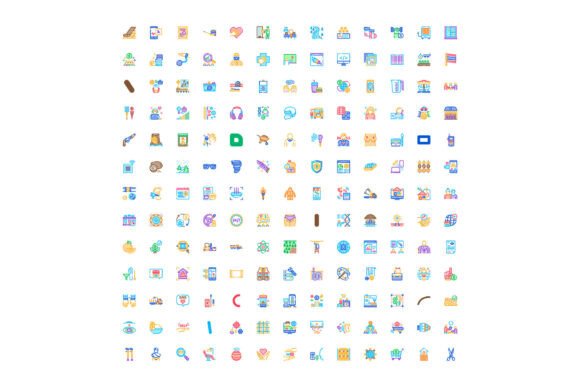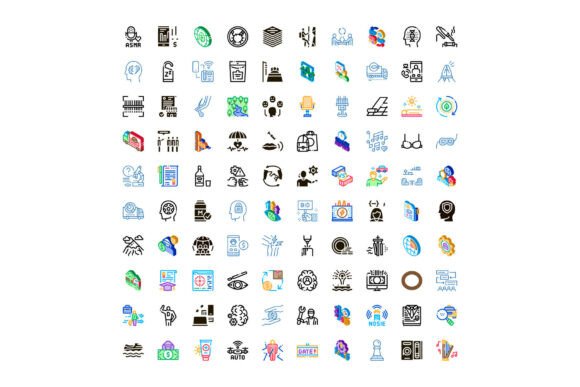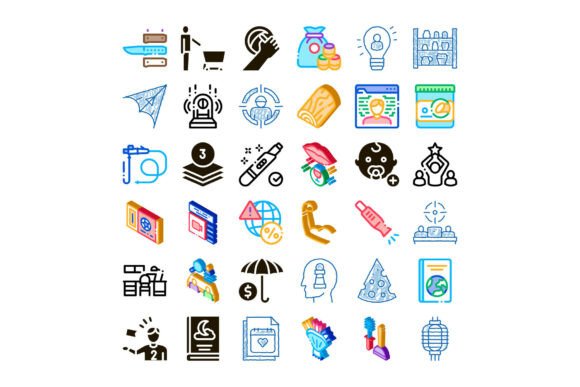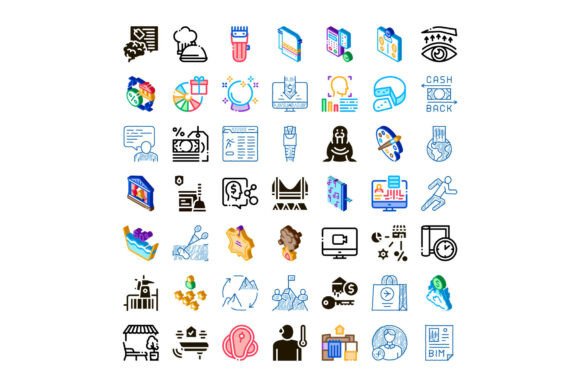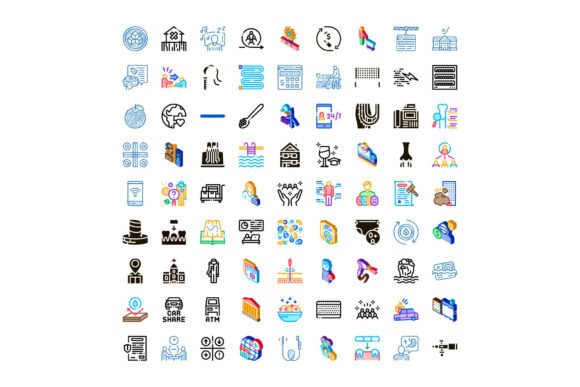
Variety of Business and Lifestyle Icons
If you’ve ever spent 20 minutes searching for the “right” icon to represent sustainability in a client pitch deck—or tried to find a clean, consistent set of finance icons that don’t clash with your brand colors—you know how much time (and mental energy) goes into visual communication. That’s where Variety of Business and Lifestyle Icons becomes more than just a download—it becomes a workflow anchor.
This isn’t a single-theme pack or a generic clipart library. It’s a thoughtfully curated collection of flat, modern icons covering business, finance, health, social connection, environmental action, and technology—designed to work together, not compete. Each icon follows consistent stroke weight, corner radius, and spacing logic, so whether you’re layering them in Figma, dropping them into a Google Slides presentation, or embedding them in a Notion dashboard, they feel intentional—not patched together.
When You Need Clarity, Not Clutter
Think about the last time you built something for someone else: a workshop handout for small business owners, a wellness newsletter for your yoga studio clients, or even a personal budget tracker in Airtable. In each case, you weren’t just sharing information—you were guiding attention, reducing cognitive load, and building trust through visual consistency. Icons do that quietly but powerfully.
A freelance marketer might use the finance icons to label income streams in a client report—not as decoration, but as instant recognition. A school counselor could pull the health and social icons to build an emotional check-in sheet for middle-schoolers—simple, non-intimidating, and culturally neutral. A climate educator might combine environmental and technology icons to illustrate how smart grids support renewable energy—making abstract systems feel tangible.
Real Use Cases, Not Just Categories
Here’s how people actually use Variety of Business and Lifestyle Icons—not in theory, but on Tuesday afternoon:
- Bloggers and content creators drop icons into listicles (“5 Ways to Reduce Digital Waste”) or comparison tables (e.g., side-by-side icons for “cloud storage,” “local backup,” and “encrypted sync”)—helping readers scan faster and retain more.
- Small business owners use the business and lifestyle set to design service menus—like pairing a briefcase icon with “1:1 Strategy Session” and a leaf icon with “Sustainable Brand Audit.” No need to hire a designer for every minor update.
- Educators and trainers embed icons into interactive PDFs or LMS modules—say, using the health icons to tag self-care prompts in a remote-work resilience course. Learners associate visuals with actions faster than text alone.
- App and web designers test icon clarity at small sizes: Does the “community” icon still read as connection at 16px? Does the “carbon footprint” icon avoid looking like a generic leaf or a recycling symbol? This collection was tested across real UI contexts—not just artboards.
- Freelancers building proposals use matching icons next to scope items—“audit,” “optimize,” “report”—so clients see structure before reading a word. It signals professionalism without jargon.
Why Consistency Matters More Than Quantity
You don’t need 500 versions of a “meeting” icon. You need one that works in dark mode, scales cleanly to 48px for mobile buttons and down to 14px for inline labels, and doesn’t require recoloring every time you switch palettes. The Variety of Business and Lifestyle Icons set was built with those constraints in mind—SVG-first, color-agnostic outlines, and optional fill layers for quick customization.
That means if you’re updating your company’s internal knowledge base and switching from blue-dominant to accessible high-contrast mode, you can batch-replace icon fills in seconds—not hours. If you’re translating a health toolkit into Spanish, the icons stay universal while only the text changes. No redesign needed.
What to Consider Before You Download or Buy
Not all icon sets are equal—and not every use case calls for the same approach. Ask yourself:
- Where will these live? If it’s mostly static PDFs or printed handouts, SVGs may be overkill—optimized PNGs at 2x resolution often suffice. But if you’re building a responsive web app or a design system, scalable vector files with semantic naming (
icon-finance-budget.svg) save real development time. - Who’s using them—and how familiar are they with your visual language? A tech-savvy startup team might appreciate subtle distinctions (e.g., “blockchain” vs. “cloud infrastructure”), but a community center staff training new volunteers may need broader, more literal symbols (“money,” “people,” “tree”). This collection balances both—offering clear primary meanings first, layered detail second.
- Do you need licensing flexibility? Some packs restrict use in client deliverables or SaaS products. Variety of Business and Lifestyle Icons includes commercial-use rights—so whether you’re designing a slide deck for your own coaching business or building white-labeled dashboards for five clients, you’re covered.
- How much time do you realistically have to customize? If you’re mid-deadline and need plug-and-play assets, look for icons with built-in alignment guides, consistent baseline heights, and pre-tested color pairings. This set includes style notes and a quick-start guide—not because it’s complicated, but because it respects your time.
Beyond Decoration: Icons as Functional Tools
Icons aren’t just visual garnish. They’re functional tools that reduce friction—between idea and understanding, between instruction and action, between your message and someone else’s retention. When a small business owner adds a simple “recycle” + “lightbulb” icon combo next to “waste reduction tip #3” in their monthly email, that’s not flair. That’s scaffolding for behavior change.
When a freelancer uses the social and health icons to map client pain points (“feeling isolated after remote work launch” → “reconnect + reset routine”), they’re not just making a pretty diagram—they’re creating shared language fast.
And when an educator selects the environmental icons to co-design a classroom “eco-audit” with students, they’re inviting participation—not broadcasting expertise.
That’s the quiet strength of Variety of Business and Lifestyle Icons: it supports doing, not just showing. It helps people communicate clearly, act intentionally, and build things that work—for real users, in real contexts, without over-engineering the basics.
So if your next project involves explaining, teaching, pitching, organizing, or simply making sense of complexity—whether it’s your first side hustle or your tenth enterprise rollout—start with icons that respect your audience’s time, your own bandwidth, and the actual work you’re trying to get done.