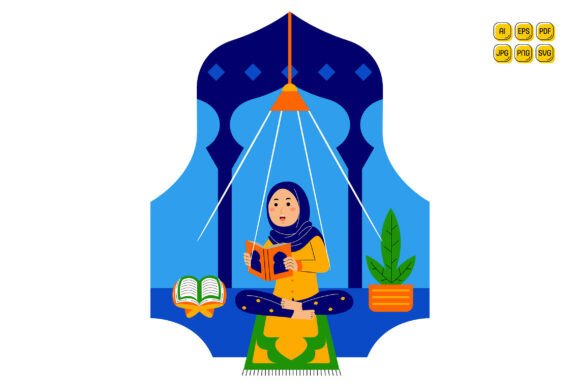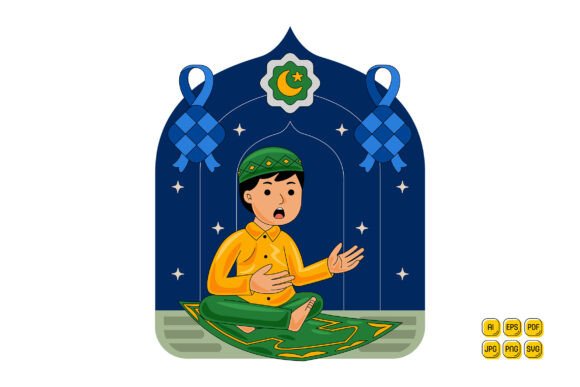
Man Reading Quran on Prayer Mat
A Man Reading Quran on Prayer Mat is more than a symbolic image—it’s a versatile, production-ready visual asset designed for real-world application across business, education, faith-based communication, and creative workflows. Built as a scalable vector illustration set, it supports consistent, high-fidelity implementation whether you’re designing a landing page for an Islamic educational platform, crafting a social media campaign for a halal wellness brand, or developing a bilingual infographic for a mosque outreach initiative.
This illustration isn’t static decoration. It functions as a modular design component—each element (prayer mat, Quran, man’s posture, background shapes, lighting accents) is individually layered and named in the source files. That means you can isolate the mat to recolor it for Ramadan branding, remove the figure to repurpose the composition as a minimalist background, or extract the Quran’s cover texture to use as a subtle pattern in a presentation deck. Its flat design style ensures clarity at any scale—from a 24-pixel favicon to a 10-foot trade show banner—without pixelation or rendering issues.
How It Fits Into Your Workflow
In practice, Man Reading Quran on Prayer Mat enters your process where visual consistency meets functional flexibility. For marketers launching a spiritual self-care app, it might appear early in wireframing: dropped into Figma or Adobe XD as a placeholder that already conveys tone, audience, and cultural resonance—saving time spent sourcing or commissioning custom art. For educators building an online course on Islamic ethics, it serves mid-process as a visual anchor in slide decks, worksheets, and downloadable reflection journals—reinforcing thematic focus without requiring new design iterations each time.
Freelancers and agencies use it later in delivery: embedding the SVG directly into client websites for crisp rendering on all devices, exporting PNGs with transparent backgrounds for email headers, or swapping Pantone colors in Illustrator to match brand guidelines before handing off final assets. Because every file format is included—AI, EPS, SVG, PDF, JPG, PNG—and all are sized to 5000 × 5000 pixels, there’s no need to upsample, retrace, or compromise on resolution during handoff or archiving.
Integration With Tools and Platforms
The Man Reading Quran on Prayer Mat illustrations integrate cleanly with tools you already use. In Adobe Illustrator, layers are logically grouped and labeled—“Figure,” “Quran_Text,” “Mat_Texture,” “Shadow”—so editing is intuitive, not exploratory. You can apply global swatches to shift the entire palette in one click, or use the Appearance panel to add subtle gradients or drop shadows without altering underlying vectors.
In web environments, the SVG version embeds natively in HTML, supports CSS styling (e.g., changing fill color on hover), and remains accessible via aria-label attributes when properly annotated. For WordPress users, it uploads directly to the Media Library and inserts cleanly into Gutenberg blocks—no plugin required. Canva users can import the PNG or SVG, then combine it with text overlays, icons, or photo layers using Canva’s drag-and-drop interface—ideal for rapid social media post creation.
When paired with other assets—like Arabic calligraphy vectors, mosque silhouette packs, or crescent moon icons—the Man Reading Quran on Prayer Mat becomes part of a cohesive visual system. That consistency strengthens recognition across touchpoints: the same color-treated mat appears in your Instagram story, your newsletter banner, and your printed annual report—building trust through repetition, not redundancy.
Practical Customization Tips
- Color adaptation: Use Illustrator’s Recolor Artwork tool to generate harmonious palettes based on your brand’s primary hex values—test warm tones for compassion-focused messaging, cool blues for calm and reflection themes.
- Contextual scaling: For mobile-first designs, export SVGs with viewBox attributes preserved; for print, use the high-res JPG or PDF at 300 DPI—no interpolation needed.
- Layered reuse: Duplicate the “Quran” layer, hide the text, and replace it with custom verses in your preferred font—keeping alignment and perspective intact.
- Combining elements: Overlay the prayer mat shape onto a world map SVG to visualize global Quran study initiatives, or place the man’s silhouette beside a speech bubble to create an “Ask an Imam” promo graphic.
Preparation and Long-Term Usability
Before first use, spend five minutes exploring the file structure. Open the AI file and review layer naming conventions—this prevents accidental deletion of key components during edits. Save a master “untouched” copy separately from working versions. Name exports clearly: man_quran_mat_web_lightblue.svg, man_quran_mat_print_300dpi.pdf. This simple step pays dividends during audits, client revisions, or when revisiting projects months later.
For teams, store the original vector files in a shared cloud folder with version control enabled. Add a brief README.txt explaining which formats suit which outputs (e.g., “Use SVG for web, PDF for print proofs, PNG-24 for email”). That reduces friction for non-designers—copywriters can grab a ready-to-use PNG for a blog header; developers can pull SVG code directly into templates.
Long-term, this set holds value because it avoids trend dependency. Flat design resists obsolescence better than photorealistic or heavily textured styles. The neutral composition—focused, serene, culturally grounded—ages gracefully. Unlike stock photos with dated clothing or expressions, these vectors remain adaptable across years of use, campaigns, and platform updates.
Real-World Implementation Examples
A small business owner launching a halal-certified meditation app uses the illustration in three ways: first, as a hero image on their homepage (SVG, centered, with soft gradient overlay); second, as a recurring icon in their onboarding flow (resized to 64px, monochrome, embedded inline); third, as a printable PDF guide cover—adding their logo and tagline in Illustrator without distorting proportions.
An educator creating a digital toolkit for teaching tajweed downloads the EPS file, imports it into InDesign, and places it alongside audio waveform visuals and phonetic charts. They adjust the mat’s opacity to 15% and use it as a watermark across 20+ worksheet pages—ensuring cohesion without competing for attention.
A freelance designer working with a nonprofit builds a Ramadan campaign calendar in Notion. Each week includes a custom graphic made by combining the Man Reading Quran on Prayer Mat with date-specific icons (lanterns, dates, moons) exported from the same vector pack—maintaining visual rhythm while delivering timely content.
None of these uses require advanced technical skill—just awareness of what the asset offers and where it fits naturally into existing habits. That’s the core advantage: it removes friction, not creativity.
Whether you’re refining a brand identity, supporting spiritual learning, or communicating values through design, the Man Reading Quran on Prayer Mat illustration set delivers precision, adaptability, and quiet authority—ready when your next project calls for clarity, respect, and visual intention.