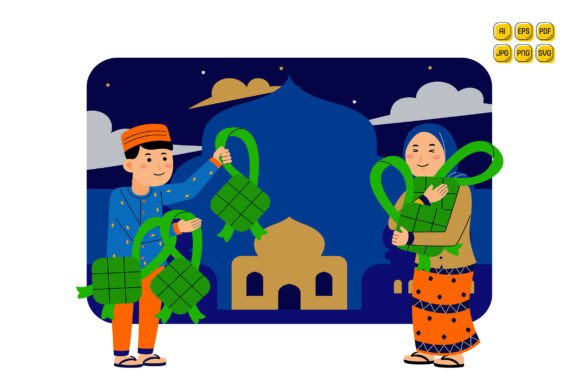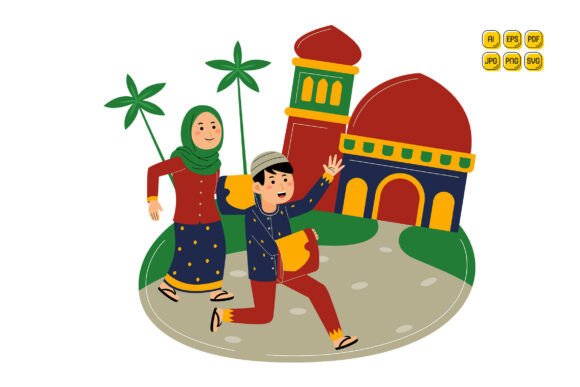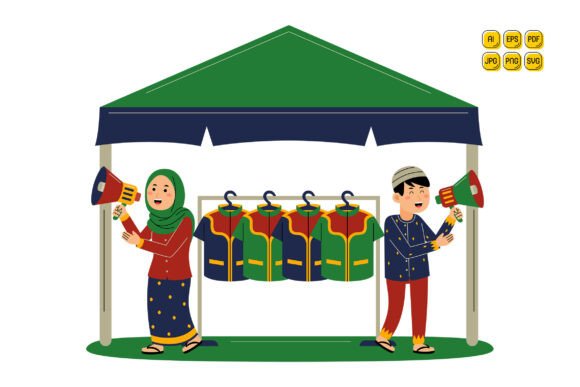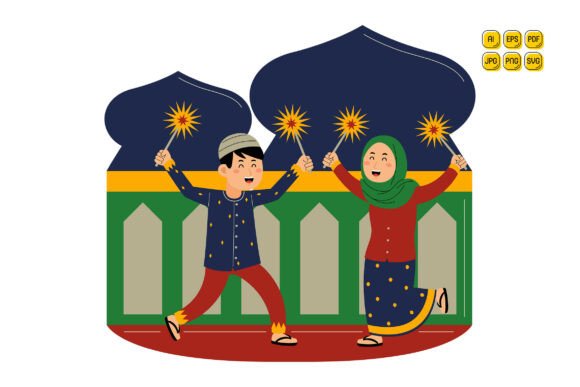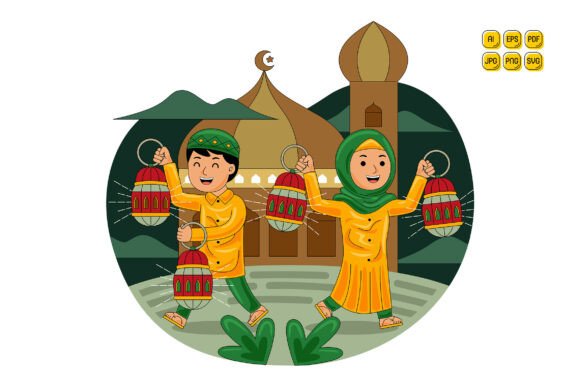
Muslim Couple Holding Ramadan Lantern
A Muslim Couple Holding Ramadan Lantern isn’t just a seasonal illustration—it’s a strategic visual asset with layered utility for professionals who understand that intentionality in imagery drives clarity, resonance, and results. When used thoughtfully, this single vector concept becomes a flexible foundation—not a decorative afterthought—for branding, communication, education, and customer engagement during Ramadan and beyond.
Why This Visual Works Beyond Aesthetics
The image of a Muslim couple holding a traditional Ramadan lantern carries immediate cultural recognition, emotional warmth, and symbolic weight: light, unity, reflection, and shared devotion. Unlike generic holiday icons, it signals specificity without exclusion—grounded in lived experience yet adaptable across contexts. That duality is rare. It allows designers, marketers, educators, and small business owners to communicate authenticity while retaining full creative control over tone, audience alignment, and message framing.
What makes the Muslim Couple Holding Ramadan Lantern especially valuable is its technical flexibility. With 100 vector illustrations included—each delivered in AI, EPS, SVG, PDF, JPG, and PNG formats—and sized at 5000 × 5000 pixels, you’re not buying a static image. You’re acquiring a modular toolkit. Every shape, line, and color can be isolated, recolored, resized, layered, or combined. That means one lantern can become part of a mosque skyline on a landing page, transform into a soft background motif for an email newsletter, or anchor an infographic about Ramadan traditions for a school curriculum—all without pixelation, licensing friction, or design dependency.
Strategic Use Cases Across Roles
How you apply the Muslim Couple Holding Ramadan Lantern depends less on what it depicts and more on what you aim to achieve:
- Branding & Positioning: A halal food brand launching a limited-edition Iftar box uses the couple illustration as a subtle watermark on packaging—softened, monochrome, placed near the seal. It signals cultural awareness without overt religious messaging, reinforcing trust with core customers while remaining inclusive for broader retail distribution.
- Social Media & Campaigns: An Islamic education nonprofit creates a weekly “Ramadan Reflection” series. Instead of repeating the same photo each week, they use the vector set to swap lantern colors (gold for gratitude, green for growth, blue for reflection), adjust clothing patterns to reflect regional diversity, and overlay short Arabic phrases in clean typography—keeping visual continuity while deepening thematic relevance.
- Educational Materials: A teacher preparing a unit on global traditions imports the vector into Canva, removes the couple’s faces (retaining silhouette and posture), and adds speech bubbles with student-written reflections. The editable nature supports accessibility, differentiation, and co-creation—turning illustration into pedagogical scaffolding.
- Landing Pages & Conversion Design: A digital marketing agency building a Ramadan campaign page for a client uses the lantern as a focal point—but flips its orientation, places it behind semi-transparent text, and animates the glow using CSS. Because the SVG is layered and labeled, developers spend minutes—not hours—implementing motion, not rebuilding from scratch.
What to Consider Before You Use It
Technical readiness matters—but so does contextual intention. A high-resolution, editable Muslim Couple Holding Ramadan Lantern doesn’t automatically improve outcomes. Its impact hinges on three quiet decisions you make *before* opening Illustrator:
- What outcome are you trying to influence? Is it recognition? Trust? Action? Clarity? If the goal is conversion, simplify the composition—remove background elements, increase contrast, pair with clear CTAs. If the goal is cultural resonance, preserve symbolic details (e.g., crescent motifs, fabric texture) but adapt color to match your brand’s existing palette—not default gold or green.
- Who needs to see this—and where? A banner for Instagram requires different cropping, hierarchy, and text spacing than a printable classroom poster. Don’t assume scalability solves context. Test how the illustration reads at thumbnail size (400px wide) and full bleed (5000px). Adjust stroke weights and negative space accordingly.
- What narrative does it support—not replace? The Muslim Couple Holding Ramadan Lantern should reinforce your message, not carry it alone. Pair it with precise language: “Join our community Iftar” works; “Ramadan vibes” dilutes intent. Let the image evoke, but let words direct.
Risks of Using Without Strategy
Without grounding in purpose, even the most versatile Muslim Couple Holding Ramadan Lantern can backfire. Common missteps include:
- Context collapse: Using the same illustration across a financial advisory firm’s Eid greeting, a children’s book about fasting, and a luxury perfume launch—without adjusting tone, detail, or symbolism—creates dissonance. Audiences sense when visuals are applied, not chosen.
- Over-customization without coherence: Recoloring every element, swapping in unrelated props (e.g., adding a laptop or coffee cup), and stretching proportions to fit layouts can erode recognizability and weaken brand memory. Consistency in adaptation is more powerful than novelty for recall.
- Assuming universality: Not all Muslim communities use lanterns the same way—or at all. Urban youth in London may connect more with minimalist line art; families in Cairo may expect intricate mashrabiya patterns. Know your primary audience’s visual literacy before standardizing.
Designing with Discipline, Not Just Tools
Having 100 vector variations is only useful if you treat them as decision points—not decoration options. Ask yourself: Which version best serves the user’s next step? Which simplifies complexity? Which invites participation instead of passive viewing?
For example, a freelancer designing a Ramadan social media kit might start by selecting *three* base illustrations—one focused on gesture (hands holding lantern), one on environment (lantern glowing in courtyard), and one on expression (couple smiling softly)—then build variations around those anchors. That approach prevents overwhelm and ensures visual logic across deliverables.
Similarly, a small business owner updating their website banner could use the PNG with transparent background to layer the couple over a real photo of their storefront—blending authenticity and symbolism. No stock photo needed. No copyright risk. Just intentional layering.
Long-Term Value Lies in Reusability—Not One-Off Use
The true ROI of the Muslim Couple Holding Ramadan Lantern emerges over time—not in a single campaign, but across cycles. Save color palettes you develop for future years. Document which compositions tested best for email open rates versus Instagram saves. Build a style guide snippet showing how the lantern integrates with your logo, fonts, and tone of voice.
That kind of reuse transforms a purchase into infrastructure. It shifts your workflow from “finding the right image” to “refining the right system.” And systems scale. Tools don’t.
So yes—this is a collection of vectors. But more precisely, it’s permission to design with confidence: to resize without compromise, recolor without loss, recombine without limitation, and represent with respect. What you do with that permission determines whether it becomes background noise—or a quiet, steady light in your work.