Muslim Couple Selling Clothes at Outdoor: A Versatile Visual Asset for Modern Creative Professionals
Visual storytelling is no longer optional—it’s foundational. In today’s fast-paced digital ecosystem, where attention spans shrink and brand authenticity rises in value, professionals across marketing, e-commerce, and content creation demand assets that are both culturally resonant and technically flexible. Enter the Muslim Couple Selling Clothes at Outdoor vector illustration set: a thoughtfully crafted, inclusive visual resource designed not just to depict a scene, but to empower scalable, on-brand communication across platforms and purposes.
What Is “Muslim Couple Selling Clothes at Outdoor” — Beyond the Literal Image
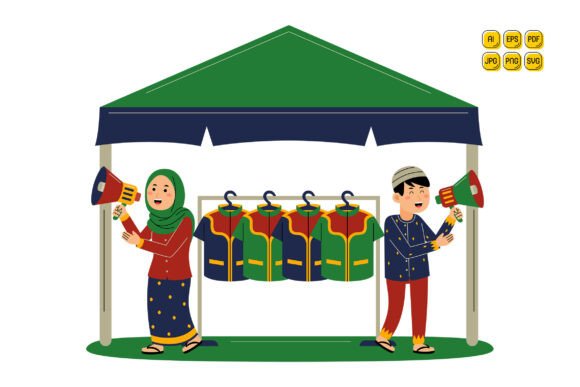
At first glance, the phrase describes a simple, warm, real-world moment: a modestly dressed Muslim couple operating a clothing stall outdoors—perhaps at a local bazaar, community fair, or seasonal pop-up market. But as a design asset, it represents something far more strategic. This isn’t a static stock photo. It’s a modular vector system: 100 hand-crafted, high-resolution illustrations built in flat design style, each fully editable down to individual shapes, colors, and layers. Every element—from the fabric folds of a hijab to the signage on a foldable kiosk—is constructed with intention, accessibility, and adaptability in mind.
Unlike generic clipart or rigid raster images, this collection supports contextual customization. Need to reflect regional diversity? Swap skin tones, headscarf styles, or garment silhouettes using editable color swatches and grouped layers. Launching a Ramadan campaign? Integrate lanterns, date palms, or calligraphic accents—already compatible with the same AI/EPS/SVG framework. Building an e-commerce landing page? Drop the PNG with transparent background directly into Figma or Webflow, then resize without pixelation to fit mobile banners or hero sections.
Why This Resonates Now: Alignment with Cultural, Creative, and Commercial Shifts
Three converging trends make Muslim Couple Selling Clothes at Outdoor especially timely—and valuable—for today’s professionals.
1. The Rise of Intentional Inclusion in Visual Language
Consumers increasingly expect representation that feels authentic—not performative. A 2023 Pew Research study found that 78% of Muslim respondents said seeing themselves reflected in advertising positively influenced their perception of a brand. Yet many creative teams still rely on outdated or stereotyped imagery—or worse, avoid representation altogether due to lack of accessible, respectful assets. This collection fills that gap: it portrays everyday entrepreneurship with dignity, warmth, and cultural specificity—without exoticism or tokenism. It’s inclusion built into the file structure, not added as an afterthought.
2. The Acceleration of Multi-Channel, Multi-Format Content Production
Modern creators don’t design for one platform—they orchestrate assets across Instagram carousels, Shopify product pages, email headers, printed flyers, animated social ads, and even AR-enabled storefront previews. That demands assets that scale seamlessly and adapt without rework. With files delivered in AI, EPS, SVG, PDF, JPG, and PNG—all at 5000 × 5000 pixels—this set eliminates format friction. SVGs retain crispness on retina displays; AI layers allow marketers to isolate the couple for testimonial overlays or swap background elements for seasonal campaigns; PNGs with transparent backgrounds integrate effortlessly into Canva templates or Notion dashboards.
3. The Growing Demand for Brand Agility Without Compromising Quality
Small businesses, solopreneurs, and agile agencies need speed—but not at the cost of polish. Waiting for custom illustrations or licensing restrictive stock photos slows iteration. This collection enables rapid prototyping: combine the outdoor stall with a “Limited Stock” badge (included), layer in a QR code icon (editable vector shape), adjust hues to match your brand palette—all within minutes in Adobe Illustrator. One designer recently used three base illustrations from the set to build a full launch kit for a halal fashion startup—spanning Instagram Stories, Google Ads banners, and a printable vendor application form—in under four hours.
Practical Applications Across Roles and Workflows
The versatility of Muslim Couple Selling Clothes at Outdoor reveals itself most clearly in real-world usage—not feature lists. Here’s how professionals are already integrating it:
- Freelance Marketers: Embedding editable vectors into Notion client dashboards—using color-coded layers to show before/after branding adjustments during presentation mode.
- E-commerce Founders: Creating dynamic product page banners by pairing the couple illustration with mockups of actual garments (e.g., overlaying a vector abaya design onto a mannequin silhouette from the same file library).
- Social Media Managers: Animating SVG elements frame-by-frame in After Effects—subtly shifting the couple’s posture or adding floating price tags for TikTok educational shorts about ethical fashion pricing.
- Nonprofit Communicators: Adapting the outdoor market setting into a community empowerment infographic—replacing clothing racks with icons representing skills training, microloans, and mentorship pathways—using the same consistent visual language.
- Web Designers: Exporting SVGs as inline code for faster-loading hero sections, with CSS-controlled hover effects on interactive elements like “Shop Now” buttons integrated into the scene.
Design Philosophy Meets Technical Precision
This isn’t just about quantity (100 illustrations) or resolution (5000 × 5000 px). It’s about design integrity. Each vector follows flat design principles—clean lines, intentional negative space, balanced proportions—ensuring legibility at any size, from app icons to trade show backdrops. All paths are outlined, fonts converted to shapes, and grouping logic follows industry-standard naming conventions (e.g., “Group_Couple_Female”, “Layer_Background_Bazaar”). Even shadow effects are built as editable gradient meshes—not rasterized filters—so lighting can be adjusted to match brand mood boards.
And because workflows evolve, compatibility is non-negotiable. The AI files open natively in Illustrator CC 2020+, EPS ensures backward compatibility with legacy print vendors, SVG supports modern web standards including accessibility attributes (ARIA labels can be added via code), and the high-res JPG/PNG deliver immediate usability for platforms that don’t accept vector uploads.
Looking Ahead: Visual Assets as Strategic Infrastructure
In the next five years, the line between “design asset” and “brand infrastructure” will continue to blur. As generative tools mature, what sets apart truly valuable resources isn’t novelty—it’s editability with purpose, cultural fluency with precision, and technical readiness for tomorrow’s platforms. The Muslim Couple Selling Clothes at Outdoor collection anticipates that shift. It doesn’t ask users to retrofit meaning into generic visuals. Instead, it offers a living, breathing foundation—one where every stroke, color, and composition decision supports both creative expression and measurable outcomes.
For professionals who understand that representation isn’t decoration but direction—and that efficiency shouldn’t mean sacrificing nuance—this is more than a download. It’s a workflow accelerator. A cultural bridge. A quietly powerful tool for building brands that resonate, scale, and endure.
Happy designing. Happy purchasing.