Medical Object Illustration: A Practical Guide for Healthcare Design Projects
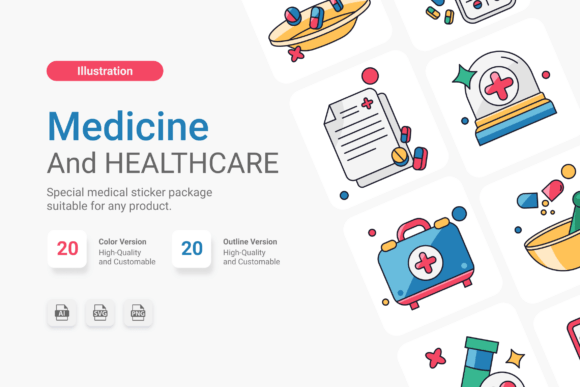
Medical Object Illustration refers to a curated, stylistically consistent collection of vector-based visuals depicting common healthcare tools, equipment, and clinical items—such as stethoscopes, syringes, ECG machines, thermometers, pill bottles, and surgical instruments. Unlike photorealistic stock imagery or generic clipart, Medical Object Illustration prioritizes clarity, recognizability, and visual cohesion while maintaining technical accuracy. It’s designed not just to look professional, but to function effectively across diverse communication contexts—from patient education handouts to telehealth app interfaces.
How Medical Object Illustration Differs from Other Visual Resources
At first glance, medical illustrations may seem interchangeable with other visual assets—but distinctions matter in practice. Stock photography offers realism but often lacks flexibility: backgrounds can’t be removed cleanly, colors are fixed, and scaling introduces pixelation. Traditional medical diagrams (e.g., anatomical cross-sections) emphasize scientific precision over usability in branding or UI design. In contrast, Medical Object Illustration is built for adaptability: clean outlines, intentional negative space, and purposeful simplification make each item instantly legible at small sizes—critical for mobile apps or infographics.
Compared to hand-drawn or painterly medical art, this set adopts a modern, geometric illustration style. Shapes are deliberate—not overly stylized, not clinically austere. Details like needle bevels, dial markings on blood pressure cuffs, or the texture of a latex glove are included where they aid recognition, omitted where they clutter. That balance reflects an understanding of real-world constraints: designers need assets that communicate quickly, scale reliably, and integrate smoothly into existing brand palettes.
Strengths for Real-World Use Cases
The practical value of Medical Object Illustration becomes clearest when matched to specific project needs. For educators developing patient-facing materials, these illustrations reduce cognitive load—complex procedures become easier to follow when paired with clear, unambiguous icons. A diabetes management guide, for example, benefits more from a simplified yet accurate insulin pen icon than from a photo crowded with reflections and shadows.
Healthcare SaaS teams building dashboards or clinical workflow tools find particular utility here. Because all files are provided as editable vectors (AI and SVG), developers and designers can adjust stroke weights, recolor elements to match accessibility contrast ratios, or export crisp assets at any resolution—without relying on external designers for minor tweaks. The inclusion of PNGs with transparent backgrounds further streamlines integration into web layouts or presentation slides.
Branding professionals working with clinics, wellness startups, or medtech companies also gain efficiency. Rather than commissioning custom icon sets—a process that can take weeks and require multiple rounds of revision—teams can begin prototyping immediately using a unified visual language. Consistency across touchpoints (website, app, printed brochures) reinforces trust, especially in health contexts where credibility directly influences user behavior.
Tradeoffs and Situational Limitations
While versatile, Medical Object Illustration isn’t universally optimal. Its strength lies in standardization—not specificity. If your project requires highly specialized equipment (e.g., a rare orthopedic drill bit or proprietary lab analyzer), this set won’t include those items. Similarly, it avoids contextual scenes: you’ll find a standalone IV bag, but not an IV bag connected to a patient in a hospital bed. Those scenarios demand custom illustration or layered compositing—beyond the scope of a modular object library.
Another consideration is stylistic alignment. Because the set follows a cohesive modern aesthetic—clean lines, balanced proportions, moderate detail—it may not suit projects aiming for vintage medical typography, hand-sketched authenticity, or maximalist data visualization. In such cases, mixing this set with complementary resources (e.g., period-accurate line art for historical content) can work, but requires careful visual editing to preserve harmony.
Finally, while the files are fully editable, effective use still assumes basic familiarity with vector software. Users unfamiliar with Illustrator or compatible tools may find the AI file less accessible than drag-and-drop PNGs—and even then, resizing without attention to stroke consistency or text legibility can degrade impact. That doesn’t diminish the asset’s quality; it simply means implementation benefits from foundational design awareness.
When to Choose Medical Object Illustration—and When to Look Elsewhere
This set shines in time-sensitive, scalability-dependent, or consistency-critical environments. Consider it ideal if you’re:
- Building a healthcare app interface and need 10+ standardized icons for vitals tracking, medication logging, and appointment scheduling;
- Designing a multilingual patient education series where visual clarity must transcend language barriers;
- Creating a responsive website for a regional clinic and need assets that render sharply on both desktop and smartphone screens;
- Developing internal training modules for new nurses and want intuitive, non-distracting visuals for equipment orientation;
- Refreshing branding for a telehealth platform and need a cohesive icon system that aligns with modern UI conventions.
Conversely, explore alternatives if your priority is:
- Narrative depth: Illustrated patient journey maps or procedural storyboards benefit more from sequential, context-rich artwork than isolated objects.
- Anatomical specificity: Educational content about organ systems or cellular processes requires scientifically validated, layered diagrams—not tool-focused icons.
- Photographic authenticity: Marketing campaigns targeting clinicians may resonate more with high-fidelity images of real devices in clinical settings.
- Custom integration: If your product’s interface relies heavily on animated micro-interactions (e.g., a pulsing heart rate icon), static vectors will need additional development work.
Practical Integration Tips
Maximizing value starts with how you use the files—not just what they are. The SVG format allows direct embedding in HTML, enabling CSS-driven color changes and responsive sizing. For print projects, the AI file preserves layers and typography, letting you adjust label placement or add localized text without raster degradation. And because all PNGs ship with transparent backgrounds, dropping them into presentations or social media graphics requires no masking or cleanup.
One underused advantage is version control. Since each object is delivered individually (10 SVGs, 10 PNGs), you can maintain lightweight asset libraries—only importing what’s needed per project. That reduces file bloat in design systems and makes updates more manageable over time. It also supports modular design thinking: treating each illustration not as a standalone graphic, but as a reusable component within a larger visual architecture.
Making an Informed Choice
Ultimately, selecting Medical Object Illustration isn’t about finding the “best” medical graphics—it’s about matching assets to your project’s functional, aesthetic, and operational requirements. Its value emerges most clearly when weighed against real constraints: timeline pressure, team skill sets, output formats, and consistency demands. It doesn’t replace custom medical illustration—but it significantly lowers the barrier to professional-grade visual communication in health-related work.
If your goal is reliable, editable, scalable, and stylistically unified representations of everyday medical objects—without the overhead of bespoke creation—this set delivers tangible utility. But if your work hinges on unique anatomy, narrative sequencing, or photorealism, allocating budget toward specialized illustration or photography remains the more appropriate path. Clarity about intent, audience, and context—not just visual appeal—guides the most effective decisions.